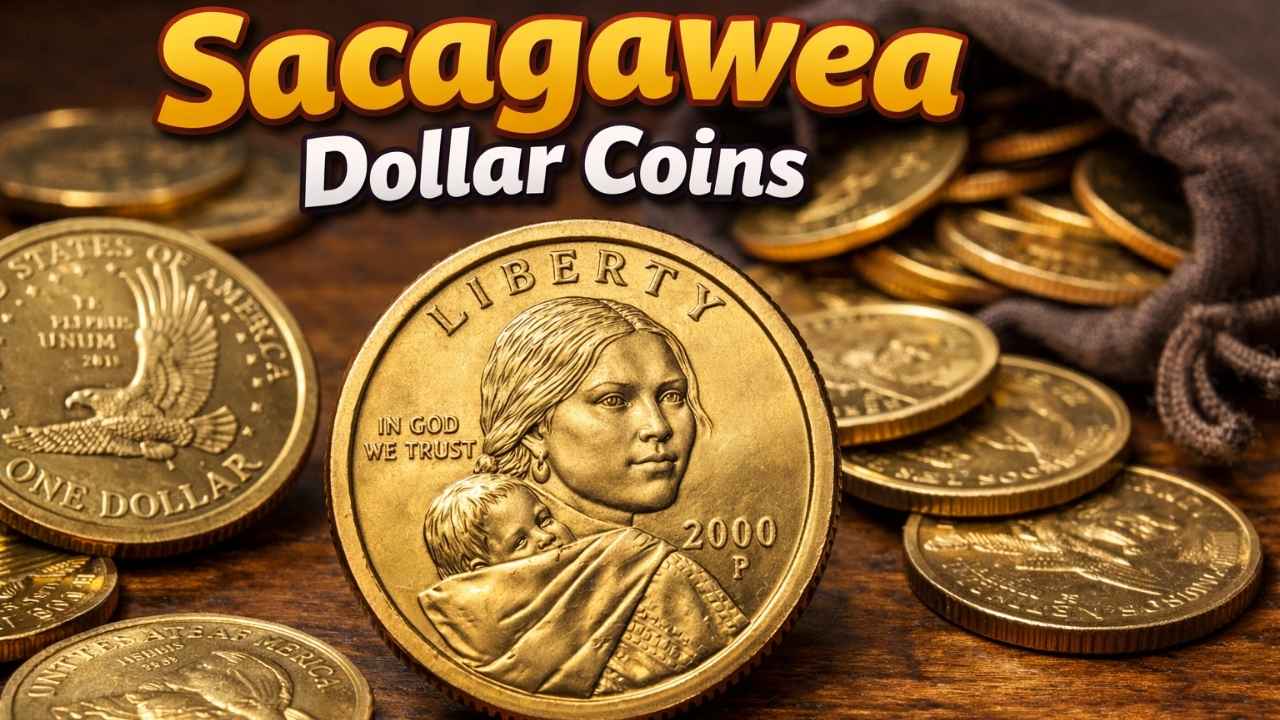
Sacagawea Dollar Coins: The Sacagawea Dollar was introduced in 2000 by the United States Mint as part of an effort to modernize American currency. The coin was designed to replace the one-dollar bill, which wore out quickly and cost more to maintain. By contrast, coins last much longer in circulation.
The coin features Sacagawea, the Shoshone woman who guided the Lewis and Clark expedition. She is depicted carrying her infant son, Jean Baptiste, symbolizing courage, guidance, and the spirit of exploration. The reverse design shows a soaring eagle, representing freedom and the American frontier.
Although the coin was intended for everyday use, it never gained widespread popularity. Instead, it found a second life among collectors, who discovered that certain rare editions and mint errors were worth far more than face value.
Why Collectors Value the Sacagawea Dollar
Collectors are drawn to the Sacagawea Dollar for its historical significance, distinctive golden color, and unique design. But the real excitement comes from rare varieties. Mint errors, prototype designs, and special editions have turned ordinary coins into treasures worth thousands or even millions of dollars.
The Sacagawea Dollar is a perfect example of how modern coinage can surprise collectors. While most coins are worth only a dollar, rare finds can change fortunes.
Mint Errors and Their Impact
Mint errors occur when something goes wrong during the coin production process. These mistakes can include double strikes, off-center designs, or mismatched dies. Because errors are rare, they make coins unique and highly valuable.
The Sacagawea Dollar series has produced some of the most famous mint errors in modern coinage history. These coins are now legendary among collectors and investors.
Special Editions and Proof Coins
Beyond errors, the U.S. Mint also produced special editions of the Sacagawea Dollar. Proof coins, presentation coins, and limited releases were struck with higher quality and given to collectors or dignitaries. These editions are now highly sought after, with values far exceeding their face value.
Proof coins are struck with polished dies, giving them a mirror-like finish. Burnished coins have a satin-like appearance. Both types are collector favorites.
Table of 14 Rare Sacagawea Dollar Finds
Here is a table summarizing 14 rare Sacagawea Dollar coins, their unique features, and estimated values in 2026.
| Coin Variety | Year | Feature | Estimated Value (2026) |
|---|---|---|---|
| Cheerios Dollar | 2000 | Prototype reverse design given in cereal boxes | $25,000+ |
| 2000-P Mule Error | 2000 | Sacagawea obverse paired with State Quarter reverse | $100,000+ |
| Goodacre Presentation | 2000 | Special finish coins awarded to artist Glenna Goodacre | $5,000–$10,000 |
| 2000-P Proof | 2000 | Proof strike with mirror-like finish | $1,000–$3,000 |
| 2000-P Burnished | 2000 | Satin finish collector edition | $500–$1,500 |
| 2001-P Double Strike | 2001 | Coin struck twice with overlapping design | $2,000–$5,000 |
| 2007-P Enhanced Finish | 2007 | Collector edition with sharp details | $300–$800 |
| 2009 Native American Series | 2009 | New reverse honoring Native contributions | $200–$600 |
| 2010-P Proof | 2010 | Limited proof edition | $500–$1,200 |
| 2012-P Reverse Proof | 2012 | Reverse proof with frosted background | $1,500–$3,000 |
| 2014 Enhanced Uncirculated | 2014 | Special collector strike | $400–$900 |
| 2015-P Dollar Set | 2015 | Included in annual collector sets | $250–$700 |
| 2018-P Innovation Series Mule | 2018 | Rare mule error with Innovation Dollar reverse | $20,000+ |
| 2021-P Proof Native American | 2021 | Limited proof honoring Native heritage | $600–$1,500 |
The Cheerios Dollar
In 2000, the U.S. Mint partnered with General Mills to distribute prototype coins in Cheerios cereal boxes. These coins featured a slightly different reverse design, making them extremely rare. Today, a Cheerios Dollar can fetch over $25,000 at auction.
The Mule Error Coin
The 2000-P Mule Error is one of the most famous modern coin errors. It was mistakenly struck with the obverse of the Sacagawea Dollar and the reverse of a State Quarter. Only a handful exist, and they have sold for more than $100,000. This error is considered one of the greatest modern coin discoveries.
Goodacre Presentation Coins
Artist Glenna Goodacre, who designed the Sacagawea Dollar, was paid with 5,000 specially finished coins. These coins have a unique burnished appearance and are highly collectible. Their value ranges from $5,000 to $10,000 depending on condition.
Proof and Burnished Editions
Proof coins are struck with polished dies, giving them a mirror-like finish. Burnished coins have a satin-like appearance. Both types are collector favorites, with values ranging from hundreds to thousands of dollars.
Double Strike Errors
In 2001, some Sacagawea Dollars were struck twice, creating overlapping designs. These double strike errors are rare and can sell for thousands of dollars. Collectors prize them for their uniqueness and rarity.
Native American Series
Starting in 2009, the U.S. Mint introduced a new reverse design each year to honor Native American contributions. These coins are collectible in their own right, with certain proof editions commanding high values.
Reverse Proofs and Enhanced Finishes
Reverse proof coins feature frosted backgrounds with polished designs, creating a striking appearance. Enhanced finish coins highlight details with sharper strikes. Both types are limited editions that attract serious collectors.
Mule Errors in Later Years
In 2018, another mule error was discovered, this time pairing the Sacagawea Dollar obverse with the reverse of an Innovation Dollar. These coins are extremely rare and can be worth tens of thousands of dollars.
The Future of Sacagawea Dollar Collecting
As we move into 2026, the market for rare Sacagawea Dollars continues to grow. Collectors are increasingly interested in modern coinage, especially rare errors and limited editions. With values climbing, now is an excellent time to explore this fascinating series.
Tips for Collectors
- Buy from reputable dealers or auction houses
- Look for coins in certified holders from grading services like PCGS or NGC
- Study mint errors and varieties to recognize valuable coins
- Keep coins in protective cases to preserve their condition
Conclusion
The Sacagawea Dollar may not have succeeded as everyday currency, but it has become a legend in the world of coin collecting. From Cheerios Dollars to mule errors, these coins represent some of the most exciting discoveries in modern numismatics. For collectors in 2026, owning one of these rare finds could mean holding a small piece of history worth a fortune.