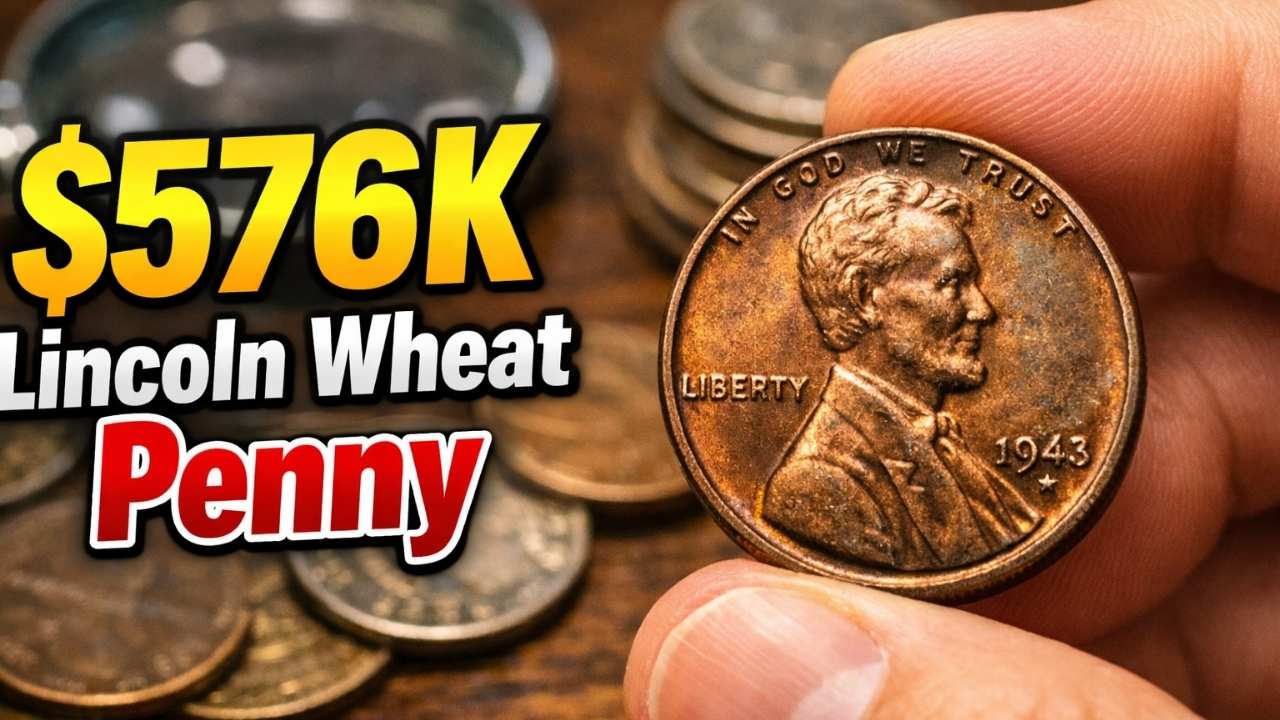
Collector’s Guide to the $576K Lincoln Wheat Penny: The Lincoln Wheat Penny is one of the most beloved coins in American numismatics. Minted between 1909 and 1958, it was the first U.S. coin to feature a real person, Abraham Lincoln, rather than a symbolic figure. While most Wheat Pennies are worth only a few cents, certain rare varieties and minting errors have elevated some examples to extraordinary value. One such coin sold for an astonishing $576,000, proving that even the smallest denomination can hold immense historical and financial significance.
Origins of the Lincoln Wheat Penny
The coin was designed by Victor David Brenner to commemorate the centennial of Lincoln’s birth. Its obverse features a portrait of Lincoln, while the reverse displays two wheat stalks framing the words “ONE CENT.” Brenner’s initials, “VDB,” appeared prominently on the reverse of the earliest issues, sparking controversy and leading to their removal. This design detail later became one of the most famous varieties in coin collecting.
Why Some Wheat Pennies Are Worth a Fortune
Several factors determine the value of a Wheat Penny:
- Mintage numbers: Coins produced in smaller quantities are naturally rarer.
- Mint marks: Pennies struck in Denver (D) or San Francisco (S) often had lower mintages than Philadelphia.
- Errors and anomalies: Misstrikes, doubled dies, and missing mint marks can create unique rarities.
- Condition: Coins in pristine Mint State condition are exponentially more valuable than worn examples.
- Historical significance: Early issues and unusual varieties carry added prestige.
The $576,000 Lincoln Wheat Penny
The penny that sold for $576,000 combined rarity with exceptional preservation. It was a near-perfect specimen of a highly sought-after variety, certified by a professional grading service. Its sharp details, original luster, and historical importance made it a once-in-a-lifetime find for collectors.
Key Dates for Collectors
Below is a table highlighting the most important Lincoln Wheat Penny dates and varieties:
| Year | Mint Mark | Variety/Feature | Notes |
|---|---|---|---|
| 1909-S VDB | S | Designer’s initials on reverse | Famous and highly valuable |
| 1914-D | D | Low mintage | Scarce and sought after |
| 1922 No D | None | Missing Denver mint mark | Rare error coin |
| 1931-S | S | Low mintage | Last scarce Wheat Penny before WWII |
| 1943 Copper | Various | Struck in copper instead of steel | Extremely rare and valuable |
| 1955 Doubled Die | Various | Strong doubling on obverse | Popular error coin |
Identifying Authentic Wheat Pennies
Collectors must learn to distinguish genuine rarities from common coins:
- Check the mint mark below the date on the obverse.
- Inspect the reverse for wheat stalks framing “ONE CENT.”
- Look for anomalies such as doubling, missing marks, or unusual coloration.
- Use magnification to spot subtle errors.
- Seek certification from grading services like PCGS or NGC for high-value coins.
Condition and Grading
Coin grading is essential for determining value. The Sheldon Scale ranges from Poor (P-1) to Mint State (MS-70). A Wheat Penny in MS-65 or higher can be worth thousands, while the same coin in Good (G-4) condition may only fetch a few dollars. Proper storage in protective holders is crucial to preserving condition.
Collecting Strategies
For new collectors:
- Begin with affordable common-date Wheat Pennies to learn identification.
- Aim to build a complete set from 1909 to 1958.
- Gradually upgrade coins to higher grades.
- Pay attention to provenance, as coins with documented history often carry added prestige.
Risks and Scams
The popularity of Wheat Pennies has led to counterfeits and altered coins. Common scams include:
- Adding fake mint marks to common coins.
- Artificially toning coins to mimic rarity.
- Selling cleaned coins as “uncirculated.”
Collectors should buy from reputable dealers and seek certification when purchasing high-value pieces.
The Cultural Impact of the Wheat Penny
Beyond monetary value, the Wheat Penny holds cultural significance. It represents a period of American history marked by industrial growth, wartime sacrifice, and national pride. For many, finding a Wheat Penny in circulation sparked a lifelong interest in coin collecting.
Conclusion
The Lincoln Wheat Penny is more than just pocket change. It is a piece of American history, artistry, and culture. While most examples are worth only a few cents, rare varieties like the 1909-S VDB, 1943 Copper, and 1955 Doubled Die can transform a collection into a treasure trove. The $576,000 penny stands as a reminder that extraordinary value can be hidden in the most ordinary places. For collectors, knowledge, patience, and careful identification are the keys to unlocking these hidden gems.